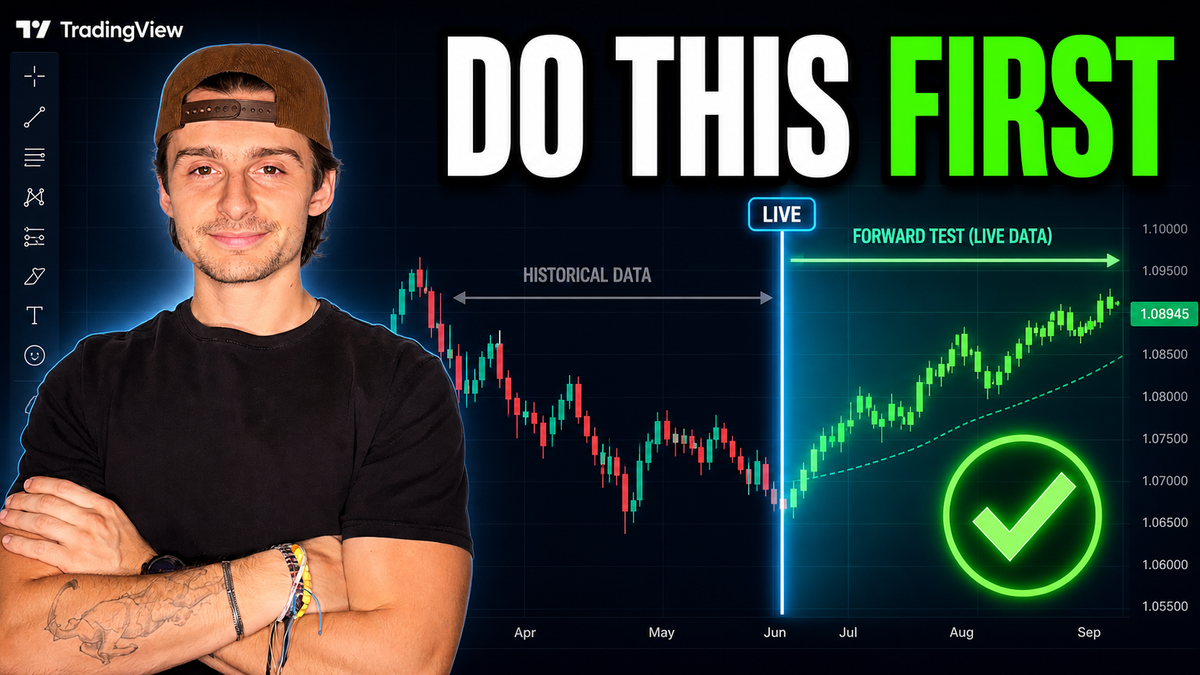

Backtests can be polished. A forward test cannot. Here is the 30-day method: what to record, how to score it, and when the result is actually worth trusting.
Every article about trading bots ends the same way: verify before you trust. Almost none of them tell you how. This one does. What follows is a forward test you can run in a spreadsheet, in about five minutes a day, against any bot, signal channel, or “AI” you are thinking of connecting to real money. It costs nothing but a month of patience, and it is immune to the tricks that make backtests lie: there is no history to fit, no future to leak, and the costs are real.
Day zero: write the rules before the first trade
The single most important step, and the one everyone skips. Before you log a trade, write down, in the spreadsheet itself, exactly how you will behave for the next 30 days.
- You take every signal the source publishes. No filtering by gut, by pair, by time of day. You are testing the source, not your mood. If the source publishes twelve signals and you like four of them, you log twelve.
- One sizing rule. Fixed-fractional: risk the same percentage of a notional account on every trade, sized from the distance to the stop. One percent of a notional $10,000 is a good default. If a source does not publish a stop, you cannot size, and the test is already over.
- Paper only. A demo account or the spreadsheet itself. Nothing at risk until the test is scored.
- The rows are append-only. You never edit or delete a past row. Mistakes get a new row with a note. This is what makes the record yours rather than a memory.
Researchers call this pre-registration. It is the difference between a test and a story you tell yourself afterwards.
The columns
| Column | What goes in it |
|---|---|
| Published (UTC) | The timestamp the source published the signal, not when you saw it |
| Asset / pair | BTCUSD, EURUSD, whatever the source trades |
| Side | Long or short |
| Entry, stop, target | Exactly as published, before the trade moves |
| Stated risk to reward | What the source claims for this signal |
| Planned size | From your sizing rule and the stop distance |
| Fill price | What paper execution actually gave you, spread and slippage included |
| Outcome | Target hit, stop hit, expired, or closed by the source |
| Result in R | Profit or loss divided by the amount risked: a stop-out is -1R, a target hit at 2:1 is +2R |
| Notes | Anything odd: a level edited after publication, a signal that vanished, a fill you could not have got |
Measuring in R rather than dollars is what lets you compare a $50 stop on one trade with a $500 stop on another. It is the native unit of a systematic edge.
The daily routine
Once a day, log any new signals with their published levels, and resolve any that closed. Five minutes. The discipline is in what you do not do: you do not skip the ugly signal, you do not round a fill in your favor, and you do not stop the test on the day the equity curve looks good. If a source’s own published record disagrees with your rows, write that down; that disagreement is one of the most valuable things the test can produce.
Scoring it at day 30
- Trade count. Fewer than 25 or 30 resolved trades and you have an anecdote, not a result. Extend the test rather than concluding early.
- Expectancy. Win rate times average winning R, minus loss rate times average losing R. Example: 25 trades, 44% winners averaging +1.9R, 56% losers averaging -1R gives an expectancy of about +0.28R per trade. That is a source worth continuing with. A 70% win rate with -3R losers is not.
- Realized versus stated. Did the risk to reward you actually got match what the source claimed? Sources that quietly widen stops or trim targets after publication show up here.
- Drawdown and streaks. Worst peak-to-trough in R and the longest run of losers. Ask honestly whether you would have kept following the rules through that stretch with real money.
- Regime. Was the month a single trend or a single chop? A good result in one regime is a hypothesis about others, not proof.
- Process compliance. Did you take every signal at the planned size? If not, you tested yourself, not the source, and the numbers describe your discipline.
The traps
Cherry-picking, changing rules mid-test, calling a good fortnight an edge, editing rows, and stopping when it looks good are the ways a forward test turns back into a backtest. Watch also for the source that improves once it knows it is being scored, and the source whose signals cannot be logged at all because they arrive as screenshots with no timestamp, no stop, or levels that change after the fact. That is not an inconvenient source. That is a failed test.
What passing looks like
Positive expectancy after realistic fills, a drawdown you could genuinely sit through, realized risk to reward close to what was stated, a published record that matches your journal, and rules you actually kept. Then, and only then, trade it small. Let live results, not the spreadsheet, decide when to size up.
Sources that make this easy are telling you something
Notice what the method demands of a source: timestamped signals, a stop and target on every one, a stated risk to reward, and outcomes you can reconcile. Sources built honestly satisfy that by design; sources built to sell you a dream cannot. It is how we built trademagic. Every signal from our certified, specialist FX models publishes entry, stop, target, confidence, and risk to reward up front, and every signal resolves to an outcome recorded in the subscriber’s history, so the reconciliation column above is a copy and paste. Traders who prefer automation can pull the same data over a read-only API and let a bot fill the spreadsheet for them; the models decide, your rules size, and our platform never touches an account.
The models trade the FX majors, not crypto, for reasons of data depth and certification we have written about before, and the same test applies to us as to anyone. Sign up at trademagic.ai, use the code TRIAL7 at signup for seven days free with no credit card, and start the journal on day one of the trial. If the first week’s process holds, keep the test running to a full month, then decide with your own numbers in front of you.
This article is educational, not personal financial advice or a recommendation to trade. Trading involves risk. Disclosure: the author is affiliated with trademagic.
