

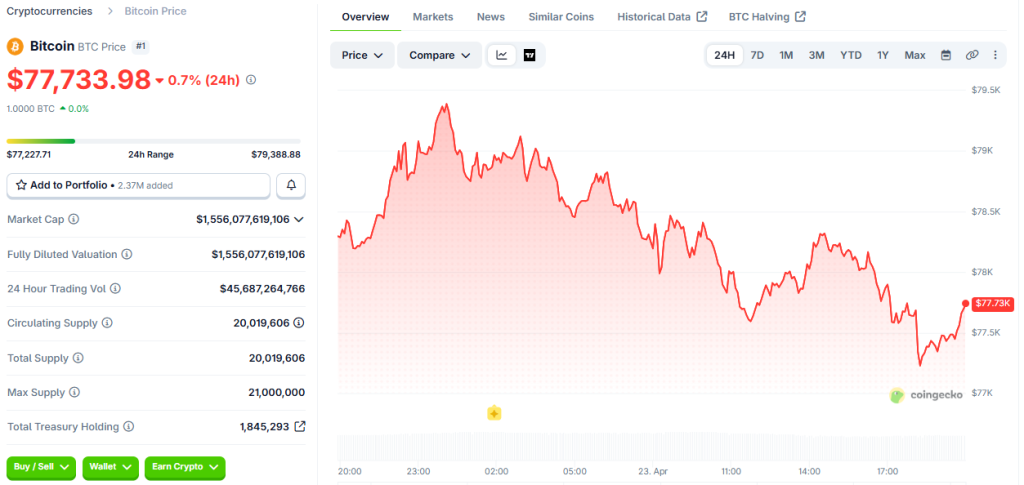
The digital asset market is currently witnessing a period of stabilized growth as institutional accumulation provides a robust foundation for the leading cryptocurrency. Analytical teams examine the current market structure where Bitcoin (BTC) has steadied at the $78,000 level following a surge of nearly 6% earlier this week.
This consolidation comes at a critical time as the asset faces significant overhead resistance while benefiting from an unprecedented streak of professional capital entry. While the broader outlook remains constructive, market participants are weighing the impact of heightened maritime tensions against the backdrop of consistent spot absorption.
One of the analytical teams at Finio24 observes that these evolving conditions signal a transition from speculative retail momentum toward a more mature, infrastructure-led phase of growth. For institutional desks tracking the financial trajectory of the sector, the current stability suggests a shift in how volatility is managed within the crypto ecosystem.
Institutional Inflows and ETF Performance Metrics
A primary driver of the current price stability is the sustained demand originating from US-listed spot Bitcoin Exchange Traded Funds. According to the latest data, these investment vehicles recorded net inflows of $335.80 million on Wednesday, extending a positive streak to seven consecutive days.
This consistent accumulation suggests that professional investors are utilizing the current price levels to build significant long-term positions. If this trend of daily absorption continues to intensify, the asset may find the necessary liquidity to challenge the psychological barrier of $80,000 in the near term.
Geopolitical Constraints on Risk Appetite
Despite the strong underlying demand, broader risk sentiment is currently being tempered by ongoing instability within global maritime trade routes. Recent reports regarding the interference with merchant vessels in the Strait of Hormuz have introduced a layer of caution into the digital asset markets.
These developments have historically dampened the appetite for risk-sensitive assets, causing a temporary pause in the aggressive price appreciation observed earlier in the month. While regional leadership has signaled a desire to maintain temporary ceasefires, the presence of active naval blockades continues to weigh on the global economic outlook.
As a result, many traders are adopting a defensive posture, awaiting further clarity before committing to new high-leverage positions. The strategic direction of the market is currently caught between the bullish influence of institutional adoption and the bearish drag of geopolitical risk.
Technical Momentum and Market Mean Recovery
From a structural perspective, the recovery of the price above the True Market Mean represents a significant shift in the broader market regime. This metric often defines the boundary between a bearish trend and a more constructive environment for long-term capital appreciation.
The current price action remains well supported by the 50-day and 100-day Exponential Moving Averages, which are situated at $72,576 and $75,435 respectively. Market momentum is currently skewed toward the upside, with the Relative Strength Index (RSI) maintaining a bullish reading of approximately 65.
While these conditions edge toward the overbought territory, the Moving Average Convergence Divergence (MACD) remains firmly positive, suggesting that buyers still retain operational control. Immediate resistance is identified at the 50% retracement level near $78,962, followed closely by the major psychological threshold of $80,000.
A sustained push through this zone would likely expose the 61.8% Fibonacci retracement level located at $83,437.
Bitcoin Price Outlook and Market Direction
The current consolidation near the $78,000 mark serves as a vital test of the market’s ability to absorb institutional demand amidst external volatility. As we progress through the remainder of April, the evolving conditions within the ETF sector will be the primary indicator of the asset’s resilience.
Investors are closely monitoring upcoming catalysts, including the potential for increased spot demand and a definitive resolution to the regional maritime standoff. The longer-term positioning of the cryptocurrency market is increasingly dependent on the stability of these professional investment flows.
A failure to maintain the current support levels could see a rapid move toward the prior channel top at $75,680, where secondary demand is expected to cluster. Maintaining institutional-grade productivity involves a disciplined adherence to these technical levels while navigating the noise of the global news cycle.
The future expectations for the sector remain tied to the successful absorption of supply by regulated investment vehicles. Monitoring the financial trajectory of the asset during this transition will be essential for any participant seeking to understand the next phase of the digital economy.
The strategic direction favored by institutional desks suggests that the path of least resistance remains tilted toward the upside, provided the ETF demand persists. Ultimately, the ability to reclaim and hold the $80,000 level will serve as the final confirmation of a new bullish market cycle.
