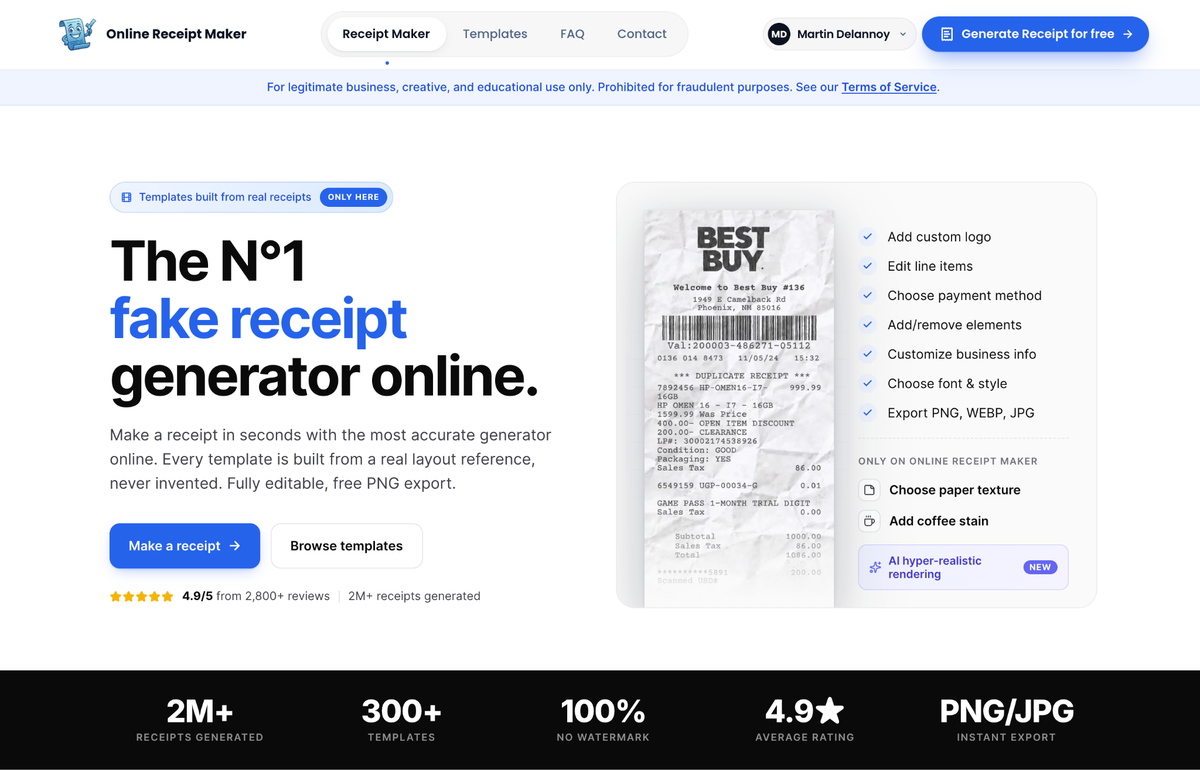

There is a big difference between a receipt that looks fine in a thumbnail and one that holds up when someone actually picks it up and reads it. For a lot of legitimate work, a prop the camera lingers on, a training example, a high fidelity mockup, the close look is exactly what you are designing for. Most fakes fall apart there, and they fall apart for predictable reasons. Here is how to make a fake receipt that survives genuine inspection.
Begin with an accurate base
You cannot polish your way out of a wrong foundation. If the template was invented rather than built from a real receipt, the font, spacing and layout are already subtly off, and no amount of careful editing fixes that. Starting from a template reverse engineered from a real scan means the structural details are correct before you touch anything, which is the precondition for everything else.
Online Receipt Maker is built on exactly this, with every template drawn from a real layout reference, so the base you start from is right rather than approximate. For anything that will be inspected closely, that accurate foundation is non negotiable.
Make the arithmetic bulletproof
The first thing anyone scrutinising a receipt does is check the math. The subtotal must equal the sum of the line items. The tax must match the stated rate applied to the subtotal. The total must equal subtotal plus tax minus any discounts. A single figure that does not reconcile is an instant tell. The reliable way to get this right is to use a tool that calculates the totals automatically, so editing a price never leaves a contradictory number behind. Never type totals by hand on a receipt that will be examined.
Get the context details right
A close reader checks plausibility, not just formatting. The store should sit at an address that could exist, with a store number in the chain’s format. The timestamp should fall within opening hours, because a purchase logged when the store was shut is a flag. Prices should match the date, since a stale fuel or grocery price on a current receipt is wrong. The items should suit the store, with nothing that would not be sold there. These are the details a careful eye catches, and they are entirely in your control.
Match the format to the brand
Generic fakes get exposed because they use one layout for everything. A receipt that passes inspection carries the format quirks specific to its kind of store: the barista line and rewards total on a coffee receipt, the pump number on a gas slip, the part numbers and core charge on an auto parts receipt, the loyalty savings on a grocery bill. Including the right structural details for the specific business is what makes a receipt read as genuine rather than as a template wearing a logo.
Add the physical realism
If the receipt exists on paper or appears at high resolution, the physical layer matters as much as the content. Real thermal receipts have texture, a faint sheen, ink that varies in darkness, and usually a crease or two. A flat, pristine print reads as generated.
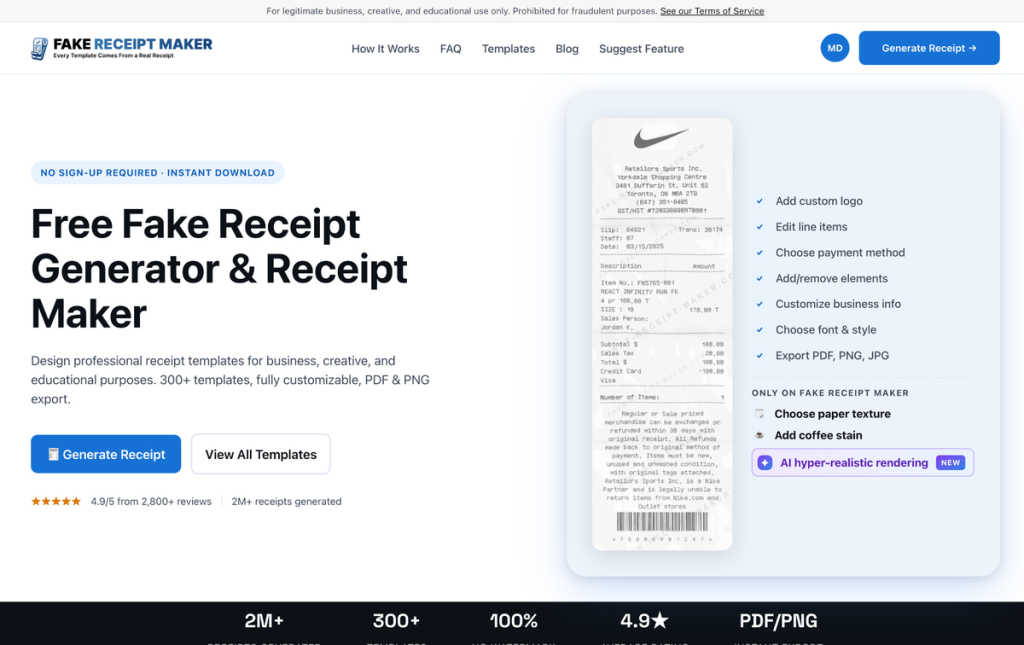
Use the realism extras, paper texture, a stain or crease, an ink variation pass, to push the file toward a real object. Tools like Fake Receipt Maker build on the same real layout approach, so the structure stays correct while you layer the physical touches on top. A receipt that is slightly worn almost always survives a close look better than a flawless one.
The final once over
Before you call it done, read the receipt as a skeptic would. Does every number reconcile? Is the store plausible and the timestamp sensible? Do the prices fit the date? Are the brand specific format details present? Does it look like a real object rather than a clean graphic? If you can answer yes to all of those, it will hold up to the kind of scrutiny that exposes lazier fakes.
Have someone else look at it
You quickly go blind to your own work, so the most reliable final check is another set of eyes. Hand the receipt to a colleague who was not involved and ask them to find anything that feels off, without telling them what to look for. A fresh viewer notices the things you have stopped seeing, an odd spacing, an item that does not fit the store, a total that reads wrong at a glance. This matters most for high stakes uses like a hero prop or a training example, where the whole point is that it survives an unprimed look. If a colleague who knows it is generated still cannot immediately say why, it will comfortably pass the casual scrutiny it was built for.
A note on legitimate use
Making a receipt that survives inspection is for legitimate work where realism genuinely matters, like props, training examples and high fidelity mockups. Both sites state their legitimate use only positioning openly on their own pages and prohibit using a realistic receipt to deceive anyone in a real transaction. Building something convincing for honest creative or professional use is the intent. Using it to actually defraud someone is illegal regardless of how well it was made.
Bottom line
A receipt that passes a close look is a stack of correct decisions: an accurate base template, bulletproof math, plausible context, brand specific format details and convincing physical realism. Skip any one and a careful reader finds it. Start from a real scan, let the tool keep the math honest, get the context and format right, and add the physical touches, and your receipt will hold up not just at a glance but under genuine inspection.
