

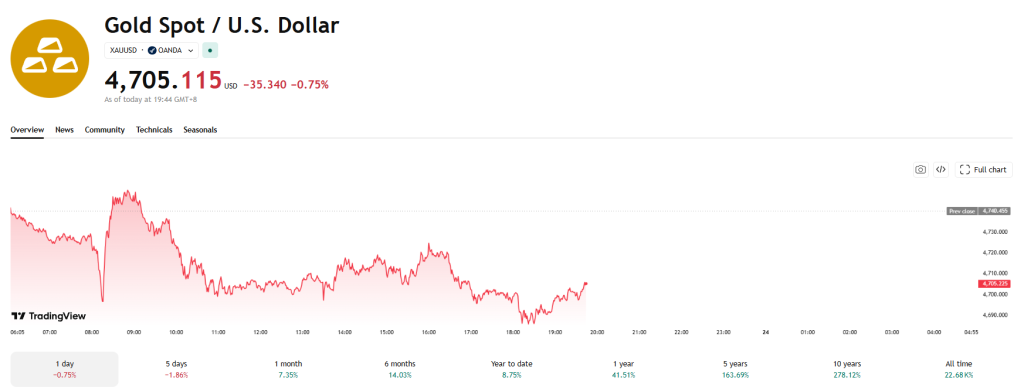
The precious metals market is navigating a period of intense volatility as a combination of macroeconomic headwinds and maritime instability reshapes investor sentiment. An financial analyst at Finio24 examines the recent price action where Gold (XAU/USD) is facing renewed selling pressure, despite displaying resilience near the critical $4,700 mark.
The US Dollar has continued to gain traction for three consecutive sessions, emerging as a primary factor undermining the valuation of the non-yielding bullion. Heightened friction regarding the naval blockade of international ports and the strategic standoff in the Strait of Hormuz remains a central theme for global commodity desks.
For institutional traders monitoring the financial trajectory of the metal, these evolving conditions represent a complex interplay between liquidity demand and a strengthening Greenback.
Naval Standoff Dynamics and Safe-Haven Flows
While recent reports suggest an extension of regional ceasefire agreements, market participants remain deeply skeptical regarding a permanent diplomatic resolution. The absence of tangible progress in peace negotiations, coupled with the recent seizure of cargo vessels, has reinforced the reserve currency status of the US Dollar.
The ongoing maritime blockade of regional ports continues to be a mandatory focal point for any resumption of formal diplomatic talks between global powers. The risk of further escalation in these vital trade corridors continues to provide a defensive floor for the USD, which conversely exerts downward pressure on Gold prices.
Maintaining institutional-grade productivity in this high-risk environment requires a careful assessment of how localized conflict impacts global capital flows.
Monetary Policy Stalemate and Inflationary Persistence
Simultaneously, the disruption of energy supplies through vital waterways has kept Crude Oil prices elevated, contributing to a substantial spike in global inflation. This inflationary environment is fueling speculation that major central banks, particularly the Federal Reserve, will adopt a more hawkish posture than previously anticipated.
After several rounds of data analysis, it is clear that sticky inflation and resilient economic activity have increased the threshold for a reduction in borrowing costs. As the Fed adopts a “wait-and-see” approach, the opportunity cost of holding non-interest-bearing assets like Gold continues to rise.
This shift in the strategic direction of US monetary policy is driving capital away from the yellow metal and toward yield-bearing dollar assets. Current future expectations suggest that unless inflation shows a definitive downward trend, XAU/USD will remain susceptible to deeper technical corrections.
The longer-term positioning of the metal depends heavily on whether the Federal Reserve prioritizes growth or price stability in the coming quarters.
Technical Support Thresholds and Momentum Shift
From a technical perspective, the XAU/USD pair is currently situated near the lower boundary of an upward-sloping parallel channel. The Relative Strength Index (RSI) is currently hovering near 39, which indicates a clear loss of bullish momentum without yet entering oversold territory.
Additionally, the Moving Average Convergence Divergence (MACD) remains in negative territory, suggesting that any immediate attempts at an upside recovery may face significant resistance. A decisive and sustained break below the trend-channel support at $4,691 would likely trigger an acceleration in selling activity.
Such a move would expose the prior structural base located near $4,568, representing a potential secondary target for bearish participants. Conversely, the bulls would require a convincing move above the channel resistance at approximately $4,926 to negate the current bearish bias.
The financial trajectory of Gold remains closely tied to the $4,700 pivot point, which serves as a psychological and technical barometer for the market. Acceptance below this level would likely signal the beginning of a more prolonged period of depreciation for the yellow metal.
Market Outlook and Future Price Direction
The convergence of regional risks and a hawkish monetary environment has created a challenging backdrop for Gold bulls as they attempt to defend key support. As we move toward the final week of April, the evolving conditions in the Strait of Hormuz will serve as the primary driver for dollar-denominated volatility.
Investors are closely monitoring upcoming catalysts, including the next Federal Reserve policy meeting and fresh updates regarding the maritime blockade. The longer-term positioning of XAU/USD will be determined by the durability of the current US Dollar rally and the stability of global inflation expectations.
The future expectations for Gold are now contingent on its ability to reclaim its role as a preferred hedge against systemic risk. Monitoring the financial trajectory of the metal at these price extremes will be vital for any participant tracking the current cycle of global economic realignment.
The strategic direction of the market remains centered on whether the $4,700 floor can withstand the pressure of a rising interest rate environment. In a world defined by persistent inflation, the value of traditional safe havens continues to be challenged by the dominance of the dollar.
