

The industrial technology landscape is witnessing a significant shift in valuation as specialized software providers capitalize on the accelerating demand for automated intelligence. Analytical teams from Finio24 examine the recent performance of Roper Technologies, which raised its full-year earnings guidance on Thursday following a robust quarterly report.
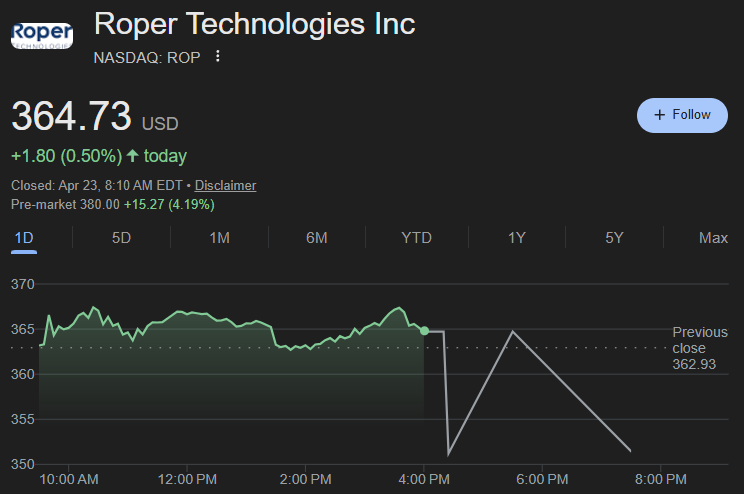
The upward revision highlights the steady demand for the firm’s diverse software portfolio as businesses across multiple sectors integrate artificial intelligence to streamline operations. Shares of the Sarasota based enterprise responded positively to the news, climbing approximately 6% in pre-market trading activity.
For institutional investors monitoring the financial trajectory of the technology sector, these evolving conditions represent a broader trend of margin expansion driven by high-value digital solutions.
Surpassing Expectations Through Specialized AI Integration
The company’s upwardly revised forecast for 2026 reflects a significant increase in adjusted profit expectations, now targeted between $21.80 and $22.05 per share. This compares favorably to the previous guidance range of $21.30 to $21.55 per share, signaling a high degree of confidence in the underlying strength of the firm’s customer base.
Revenue for the first quarter reached $2.10 billion, exceeding the consensus analyst estimate of $2.07 billion as the speed of product execution accelerated. On an adjusted basis, the company reported earnings of $5.16 per share, a notable outperformance against the projected $4.98 per share.
This success is largely attributed to the rapid shipping of new AI-enhanced products, which allow enterprise clients to automate routine administrative tasks and improve overall organizational efficiency.
Maintaining institutional-grade productivity in this environment has required the firm to expand its internal capacity for AI development while maintaining a rigorous focus on execution speed. The strategic direction of the enterprise continues to prioritize high-margin software recurring revenue over traditional industrial hardware.
Acquisition Strategy And Portfolio Expansion Metrics
A central component of the company’s growth model remains its aggressive pursuit of strategic acquisitions to broaden its technological footprint. Recent moves to acquire healthcare software leader CentralReach, alongside Procare Solutions and Transact Campus, have significantly widened the company’s reach into specialized niche markets.
While these acquisitions have increased operational expenses in the short term, they have provided the necessary scale to dominate critical software verticals. This expansion strategy is designed to capture the “sticky” revenue characteristic of enterprise-level software, where high switching costs provide long-term stability for the financial trajectory of the firm.
By integrating AI capabilities across these newly acquired platforms, the company is creating a unified ecosystem that addresses the specific automation needs of its diverse client base. The future expectations for the portfolio suggest that further consolidation in the software space may be on the horizon as the firm seeks to deploy its substantial remaining capital.
Capital Allocation And Shareholder Returns
In a move that signals strong internal liquidity and long-term optimism, the board of directors has authorized an additional $3 billion for share repurchases. This brings the total remaining capacity for buybacks to $3.8 billion, providing a significant mechanism for returning value to shareholders in the coming quarters.
This decision reflects a balanced approach to capital allocation, where inorganic growth via acquisitions is paired with direct support for the equity valuation. The strategic direction regarding share repurchases is often viewed by institutional holders as a sign that management believes the current stock price does not fully reflect the potential of its AI initiatives.
Investors are monitoring upcoming catalysts, including potential new acquisition announcements and the rollout of next-generation automated tools for the healthcare and education sectors.
The longer-term positioning of the company is now firmly rooted in its ability to remain an essential infrastructure provider for the digital transformation of professional services. As more organizations transition from experimental AI use cases to production-grade automation, the demand for specialized, vertical-specific software is expected to remain resilient.
The Road Ahead for AI and Revenue Growth
In conclusion, the decision to raise the 2026 profit forecast underscores the fundamental shift in the company’s business model toward a software-first approach. The integration of artificial intelligence is no longer an optional feature but a primary driver of revenue growth and customer retention.
Monitoring the financial trajectory of the firm will provide essential insights into how diversified technology conglomerates can successfully pivot toward high-growth digital markets. Ultimately, the future expectations for the enterprise are tied to the continued adoption of automated administrative solutions across its core healthcare and education verticals.
The strategic direction remains clear: leverage the current AI boom to solidify its position as a market leader in niche software applications. As the digital economy matures, firms that provide the “plumbing” for automated intelligence will likely remain at the forefront of the next technological cycle.
